

Veterinary Fluralaner Liquid Factory: Manufacturing Processes and Quality Standards
2026-09-23
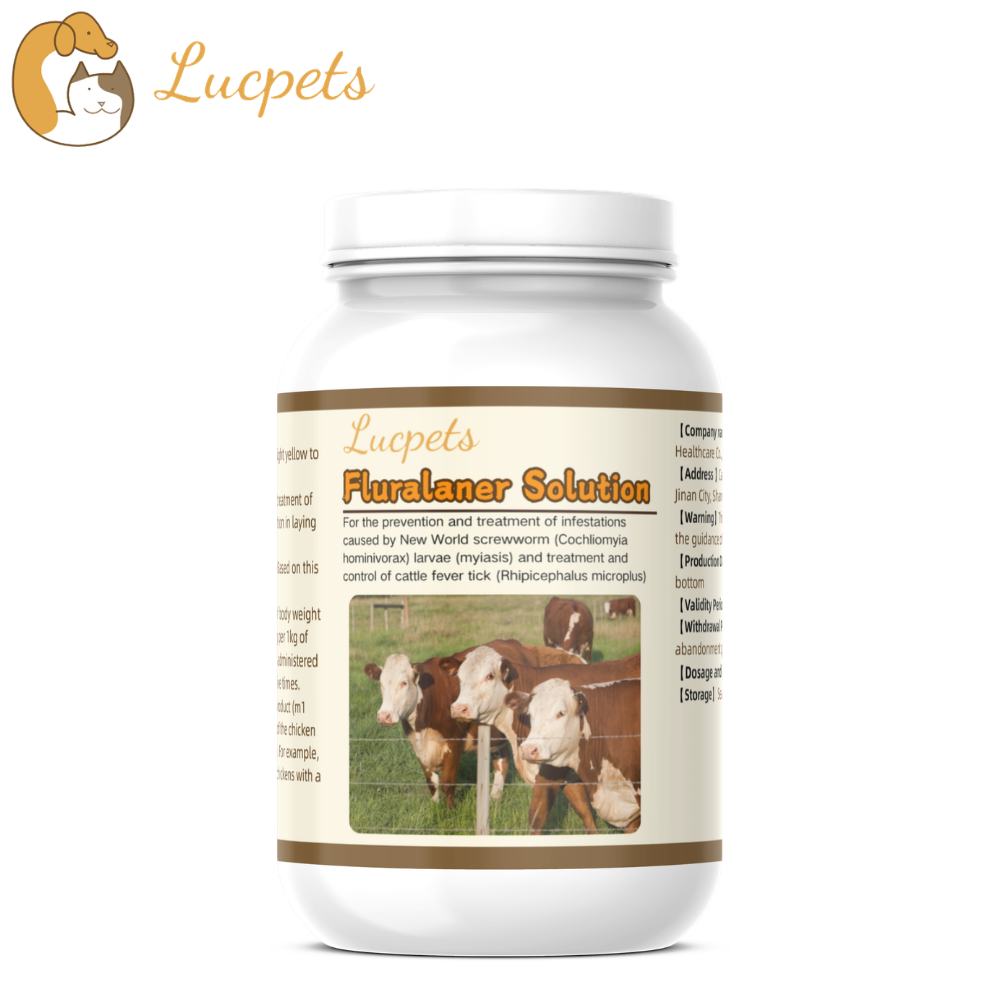
Veterinary fluralaner liquid isn’t just another bottle on the shelf—it’s a promise to pets and their owners that parasite control works exactly as prescribed. But that promise starts long before the first drop is administered. From reaction kettles to final QC release, every step in the manufacturing process shapes potency, purity, and safety. This post walks you through the real factory floor behind fluralaner production and the quality standards that keep failures off the market. Look inside the process that Lucpets holds itself accountable to.
Raw Fluralaner Characterization Before It Enters the Mixing Vessel
Fluralaner arrives as a crystalline powder with a slightly off-white to pale yellow hue. Before any blending occurs, we verify its identity through Fourier-transform infrared spectroscopy, matching the spectrum against a verified reference standard. The particle size distribution is checked via laser diffraction, as excessive fines can lead to dust generation while overly coarse particles may compromise homogeneity in the final mix.
Moisture content is determined by Karl Fischer titration, targeting a residual water level below 0.5% to prevent hydrolytic degradation. Residual solvents from the final synthesis step are quantified using headspace gas chromatography, ensuring compliance with pharmacopeial limits. Additionally, the powder’s bulk and tapped densities are recorded to anticipate flow behavior when transferred into the blending equipment.
Thermal stability is screened using differential scanning calorimetry, confirming that no polymorphic transition occurs under typical processing temperatures. Any batch showing unexpected endothermic events or discoloration is quarantined for further investigation. These pre-mixing checks create a reliable baseline, allowing the mixing step to focus solely on achieving uniform drug distribution without hidden variability from the raw input.
Why Solvent and Surfactant Choices Control Liquid Stability
The base solvent sets the energetic landscape for every other component. A high-polarity solvent can shield charged head groups but may also strip loosely bound counterions, weakening electrostatic repulsion and inviting droplet aggregation. Solvents with intermediate dielectric constants often maintain a delicate balance: enough polarity to support ionic dissociation, yet low enough water uptake to prevent hydration-driven phase splitting. This balance shifts with temperature and salt load, which is why a formulation stable in one solvent can fail after minor adjustments in co-solvent ratio.
Surfactants operate at the interface, but their true influence shows in how they pack under stress. A surfactant with a bulky hydrophobic tail and small head group forms a dense, low-curvature film that resists coalescence, yet it may struggle to re-spread after a sudden surface expansion. Conversely, a high-HLB surfactant lowers interfacial tension quickly but can promote micellar transport of oil into the aqueous phase, a pathway for Ostwald ripening. The choice is never about a single number; it is about matching the surfactant geometry to the solvent's cohesive energy and the expected shear or thermal history.
When solvent and surfactant are mismatched, the system may appear stable initially then fail after storage. Gel networks or lamellar phases formed by anionic surfactants in certain solvents can trap droplets, but if the solvent slowly alters surfactant solubility or leaches a co-solvent, the network collapses. Therefore screening must include time-dependent tests under realistic temperature cycling, not just a single snapshot of particle size or zeta potential.
Inline Homogenization and Particle Size Reduction for Uniform Dosing
Achieving uniform dosing in pharmaceutical suspensions and emulsions often hinges on controlling particle size before the formulation reaches the filling line. Inline homogenization tackles this by subjecting the product stream to intense shear, cavitation, or impact forces as it flows, breaking down agglomerates and coarse droplets without the need for batch transfer. This continuous approach minimizes hold times where sedimentation or phase separation can start to skew potency.
Pairing the homogenizer with an inline particle size reduction step—such as a wet mill or a high-pressure valve—creates a closed loop that can respond to real-time particle size measurements. If oversized particles are detected, the system adjusts rotor speed or milling gap on the fly. The result is a narrow size distribution that remains stable from the start of a run to the end, which is particularly critical for low-dose APIs where a few large particles can produce a significant overage or underage in a single unit.
Operationally, this setup removes the variability seen with manual sampling and off-line milling. It also supports continuous manufacturing by eliminating the batch boundary, letting operators correct deviations immediately rather than reworking an entire lot. For products that demand tight content uniformity, the combination of inline homogenization and controlled size reduction turns particle engineering from a batch quality check into a process parameter.
Sterile Filtration and Aseptic Filling: Where Contamination Risks Peak
The moment a sterile product passes through the final filter, every subsequent step becomes a high-stakes race against invisible intruders. Aseptic filling rooms are not merely clean spaces; they are tightly choreographed environments where human movement, equipment surfaces, and even the air itself can sabotage sterility. What many fail to appreciate is that the greatest vulnerability often lies not in the filter itself, but in the transfer lines, filling needles, and the momentary exposure between container and closure. A single turbulent airflow pattern during vial conveyance can deposit more viable particles than a hundred faulty seals.
Operators tend to focus on filter integrity testing and forget that contamination risks peak precisely when sterile fluid meets non-sterile boundary zones. The rubber stopper, the glass neck, the crimping tool—each represents a junction where sterility is either maintained or lost in fractions of a second. Real-world data from environmental monitoring often shows that the highest excursion rates occur during routine interventions: a glove entering the critical zone, a dropped vial, a momentary slowdown in the filling line. These are not dramatic failures but small, cumulative breaches that standard operating procedures rarely capture until it is too late.
To genuinely reduce risk, manufacturers must stop treating aseptic filling as a static process and start viewing it as a dynamic interplay of pressure, velocity, and human behavior. Smoke studies alone are insufficient; they show airflow direction but not the chaotic reality of particle shedding from gowning materials or the micro-turbulence created by moving parts. The smartest facilities now design for non-intervention, using restricted access barrier systems and automated lyophilizer loading not because they are trendy, but because every time a person enters the critical zone, the probability of contamination spikes exponentially. In the end, the peak risk is not a fixed location—it is the moment of transition, and that is where sterility battles are won or lost.
Release Testing: Assay, Related Substances, and Endotoxin Limits
Release testing for assay confirms that the active ingredient or potency of the batch sits within a narrow, pre-approved range. Depending on the molecule, this may involve a chromatographic separation with UV detection, a cell-based potency readout, or an enzymatic activity measurement. The result is compared against a reference standard and reported as percent of label claim, IU/mg, or U/mg. Typical acceptance bands run from 90.0 to 110.0 percent for small molecules and 80 to 125 percent for certain biologics, reflecting the method's inherent variability.
Related substances testing covers process impurities, degradation products, and any peaks that are not the active entity. A single unknown impurity is usually capped at 0.10 or 0.15 percent, while total impurities may be limited to 1.0 or 2.0 percent depending on dose and treatment duration. The method is generally a gradient HPLC or UPLC run with UV or mass spectrometric detection, and the acceptance table lists each specified impurity by name or relative retention time. When a new impurity appears above the identification threshold, the synthetic route or storage conditions receive a closer look.
Endotoxin limits are calculated from the maximum human dose per kilogram per hour and the route of administration, usually using the K/M ratio. For intravenous products the limit is commonly 5 EU/kg/hour, which translates into a much lower EU/mL value for concentrated formulations. Testing relies on Limulus amebocyte lysate (LAL) or recombinant Factor C methods, and release occurs only when the measured endotoxin level falls below the calculated limit. Tighter limits often apply to intrathecal or ophthalmic products because those tissues are considerably more sensitive.
Stability Studies and Real-Time Monitoring Under ICH Climatic Zones
Assigning a product to the correct ICH climatic zone sets the foundation for its stability program. Zone I calls for 21 °C and 45% relative humidity, Zone II shifts to 25 °C and 60% RH, while Zones III and IVa operate at 30 °C with 35% and 65% RH respectively. Zone IVb, which reflects the most demanding hot and humid environments, uses 30 °C and 75% RH. Real-time monitoring in these conditions goes beyond collecting data points — it involves mapping chamber performance, verifying sensor placement against load patterns, and responding to excursions before they become compliance issues.
A robust monitoring strategy treats the chosen zone as a living condition rather than a static target. Temperature and humidity probes should be redundant, with data reviewed at least daily and alarm thresholds set tight enough to capture drift early. Trending the continuous records often reveals seasonal shifts inside the chamber that are invisible in monthly pull samples. When a product spends time under accelerated or intermediate conditions alongside its long-term chamber, the real-time data helps distinguish actual degradation trends from transient equipment fluctuations. That distinction matters during regulatory inspections and when deciding whether a batch can safely remain on the market.
FAQ
Fluralaner has very low aqueous solubility and tends to aggregate if not properly dispersed. The manufacturing line uses a two-stage high-shear mixing process with a co-solvent system built around polyethylene glycol and propylene glycol. Temperature is kept between 20 and 25°C because higher heat can degrade the isoxazoline ring. A vacuum deaeration step removes trapped air that would otherwise cause foaming during filling.
Each batch is sampled at three points during recirculation: after initial dispersion, after final dilution, and during filling. Viscosity is checked with a rotational viscometer at 25°C, while active content is measured by a validated HPLC method. If viscosity drifts more than 5% from the reference value, the batch is held until the solvent ratio is corrected through a controlled addition loop.
The facility follows a wet-area hygiene concept. Bulk liquid passes through a 0.45 µm filtration step before filling, and the filling zone operates under positive air pressure with HEPA filtration. Preservative efficacy testing is performed on every batch according to Ph. Eur. 5.1.3, and bioburden limits are set at no more than 100 CFU/mL before filtration.
Method validation covers specificity, linearity, accuracy, precision, and robustness. Forced degradation studies expose the liquid to acid, base, peroxide, heat, and UV light. The resulting chromatograms must show baseline separation between fluralaner and all major degradants, with a resolution factor of at least 2.0. System suitability is run before every sample sequence.
Oxidative degradation and photolytic breakdown are the two biggest concerns. The liquid is filled into amber PET or glass bottles with induction-sealed closures to limit oxygen ingress. Long-term stability is monitored at 25°C/60% RH and 40°C/75% RH for six months. Any batch that shows more than 10% loss of active or appearance of a new impurity above 0.5% is rejected.
The filling line uses a peristaltic pump with in-line checkweighing. Every filled bottle is weighed within ±0.2 g of the target fill weight, and the line stops automatically if three consecutive bottles fall outside the range. Between product campaigns, the entire circuit is cleaned with hot water and a validated alkaline detergent, then rinsed until conductivity drops below 1 µS/cm.
Each incoming lot of fluralaner API is tested for identity, assay, related substances, residual solvents, and particle size distribution. Solvents and preservatives require certificates of analysis plus periodic confirmatory testing. No material is released without matching the approved supplier audit and a quarantine period of at least five working days.
Conclusion
At the Veterinary Fluralaner Liquid Factory, incoming fluralaner isn't trusted on certificate alone. Before the first valve opens into the mixing vessel, raw material undergoes a battery of characterization tests—identity by infrared spectroscopy, purity by HPLC, particle size distribution, and residual solvent screening. This preemptive step weeds out polymorphic inconsistencies that would later wreck solubility. The formulation itself hinges on solvent and surfactant selection; a poorly matched co-solvent system can trigger recrystallization within weeks, while the right surfactant blend maintains a thermodynamically stable micellar solution across temperature swings. Once the liquid base is assembled, inline homogenization takes over. High-shear rotor-stator units and, for tighter specs, high-pressure homogenizers shave droplets and crystals into the submicron range, ensuring every milliliter withdrawn from the finished tank carries the same fluralaner load.
Contamination control reaches its most unforgiving stage during sterile filtration and aseptic filling. Here, the factory treats every connection as a potential breach point: sterilizing-grade filters are integrity-tested before and after use, fill lines are steamed in place, and environmental monitoring data from the filling zone dictate batch acceptance. But sterility isn't the only gate. Release testing demands a full panel—assay for active content, related substances to catch oxidative or hydrolytic degradants, and a strict endotoxin limit suitable for parenteral or oral veterinary use. Long-term confidence comes from stability studies run under ICH climatic zones, with real-time monitoring feeding back into formulation tweaks. Samples stored at zone IVb heat and humidity reveal whether the surfactant package can hold fluralaner in solution when the cold chain fails, a practical concern for field veterinarians in tropical regions. That data loop, not just a final certificate, is what keeps each batch dependable from first drop to last dose.
Contact Us
Contact Person: Aaron
Email: [email protected]
Tel/WhatsApp: +86 18177165140
Website: https://www.lucpetsglobal.com