

How China Tunnel Freezer Boosts Efficiency in Frozen Food Production
2026-11-16
Walk onto almost any frozen food production floor and you'll hear the same pain point: freezing is where throughput slows to a crawl. A China tunnel freezer changes that equation by replacing batch-style bottlenecks with a continuous, high-velocity cold chain that locks in texture and cuts cycle times. For operators ready to stop fighting their freezer and start scaling output, Worldbase offers a closer look at how the right tunnel design turns a cost center into a competitive edge.
Why Chinese Tunnel Freezers Outperform Batch Systems on Speed
The core reason lies in how the two systems handle product flow. A batch freezer processes everything in discrete loads: you fill the chamber, wait for the entire load to reach target core temperature, then empty it and repeat. Every cycle includes dead time for door opening, warm air infiltration, and defrost recovery. Chinese tunnel freezers, by contrast, move product on a continuous belt through a controlled temperature zone. Items enter at one end and exit frozen at the other, so freezing happens in parallel with loading and unloading. There is no waiting for a full chamber to equilibrate, which immediately removes 15 to 30 minutes of non-productive time per cycle.
Chinese manufacturers have optimized airflow dynamics. Many tunnel designs use high-velocity directed air nozzles above and below the belt, stripping away the boundary layer of warm air around each product. This dramatically raises the convective heat transfer coefficient compared to the relatively still air inside a batch cabinet. For small or thin items like dumplings, shrimp, or diced vegetables, core temperatures can drop from +20°C to -18°C in under eight minutes. Batch systems often need thirty to fifty minutes for the same load. That speed gap widens further when you factor in the ability to tune belt speed to product thickness, something a fixed batch timer cannot match.
Another overlooked factor is line integration and redundancy. Chinese tunnel freezer suppliers typically offer units with quick-change belt materials, CIP systems, and variable-frequency drives that ramp up or down based on upstream production rate. If a batch freezer goes down for defrost or cleaning, the whole line stops. With a tunnel freezer, you can often continue running product through a bypass or schedule micro-defrosts during natural line pauses. The result is not just faster freezing per kilogram, but higher overall equipment effectiveness across a full production day. That is why plants producing high-volume frozen foods increasingly choose Chinese tunnel systems over older batch chambers.
Airflow Dynamics in Tunnel Freezers Matter More Than Temperature Alone
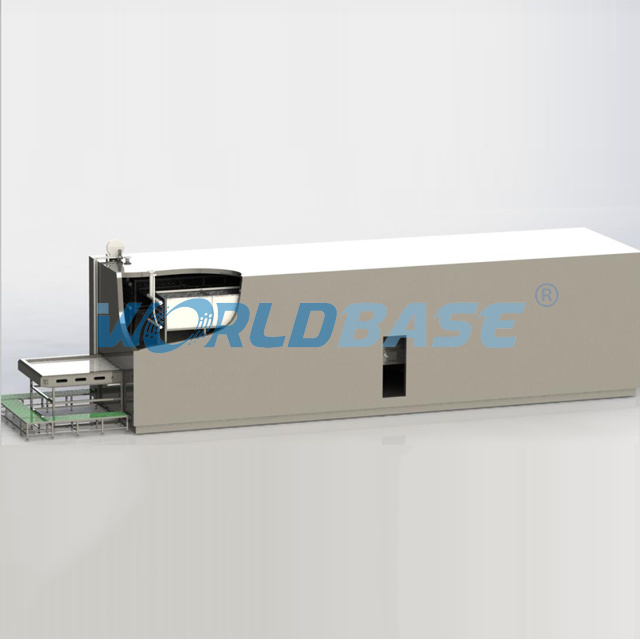
Most operators fixate on setpoint temperatures when troubleshooting freezing issues, yet the real culprit often hides in the air's movement. A tunnel freezer is not a static cold box; it's a fluid system where velocity, turbulence, and direction dictate how quickly surface moisture flashes off and how evenly the core temperature drops. Two freezers running at identical -30°C can deliver wildly different results if one has dead zones near the belt edges while the other maintains a laminar sweep across the product. Ignoring airflow means accepting unpredictable dwell times, patchy crust formation, and energy bills that don't match output.
The interaction between fan placement and product loading creates a feedback loop that thermometers alone can't capture. Dense rows of packaged goods act as baffles, forcing air to accelerate through narrow gaps or stall behind flat surfaces. This is why IQF vegetables freeze faster than stacked trays at the same temperature: the individual pieces allow high-velocity air to wrap around each item, stripping latent heat continuously. Without mapping actual air patterns with smoke tests or anemometer grids, you're essentially guessing where the cold goes, and that guesswork compounds into quality drift across shifts.
Practical control starts with treating airflow as a variable you can tune, not a fixed consequence of the blower's design. Adjustable slot nozzles, perforated belt sections, and variable frequency drives on circulation fans give you levers to redirect energy where the product needs it most. Small changes—like angling a deflector plate ten degrees or balancing return air paths—can improve core temperature consistency by several degrees without touching the refrigeration setpoint. When you stop worshipping the thermometer and start choreographing the wind, freezing becomes less about brute cooling capacity and more about precision thermal work.
Energy Savings From Chinese Designs Don't Cut Into Throughput
Chinese engineering teams have taken a different route by treating energy efficiency as a design constraint rather than an afterthought. In networking gear and server platforms, dynamic voltage scaling and fine-grained power gating adjust consumption on the fly without dropping packet processing rates. When traffic surges, cores ramp up immediately; when it lulls, they shed wattage in microseconds. The result is that throughput remains flat even as power draw falls by double-digit percentages.
Cooling innovations play an equally important role. Direct-to-chip liquid cooling and rear-door heat exchangers, increasingly common in Chinese data center builds, remove heat more effectively than forced air while requiring far less fan energy. Because hot spots vanish, processors avoid thermal throttling and can sustain higher clock speeds for longer stretches. This means the thermal management savings do not come at the expense of compute output; in many cases, sustained throughput actually improves.
At the system level, Chinese designs lean on workload-specific accelerators and smart scheduling to boost work per watt. Offloading encryption, compression, and packet forwarding to dedicated silicon frees general-purpose cores to handle more application traffic. Field reports from operators show that after swapping in these designs, they see lower utility bills alongside stable or rising transaction volumes. Energy savings and throughput are no longer opposing goals, but two sides of the same engineering effort.
One Tunnel Freezer Can Handle Multiple Product Shapes
A single tunnel freezer rarely gets boxed into one product category. The belt, airflow pattern, and temperature zones can be adjusted to accommodate everything from flat patties and round meatballs to irregular seafood pieces or extruded dough shapes. Operators can run entirely different items back-to-back without lengthy changeovers, since the freezing chamber itself doesn't care about the geometry of what passes through it.
The key lies in how the cold air is directed. Some products freeze best with high-velocity air from above, while others benefit from a balanced top-and-bottom blast that locks in shape and prevents sticking. Adjustable nozzles, variable belt speeds, and modular zones let the same tunnel handle thin fillets, chunky nuggets, or even trayed meals. Rather than dedicating separate lines to each shape, a well-tuned tunnel shifts from one to the next with only minor tweaks.
This flexibility reduces floor space, cleaning overhead, and capital costs. A facility that produces three different frozen formats can rely on one robust tunnel instead of three specialized units. When a new product shape enters the lineup, the tunnel is adapted with new belt guides or airflow settings—no need to rip out the entire line and start over.
Automation in Chinese Tunnel Freezers Cuts Labor Without Complexity
Chinese tunnel freezers have long been workhorses in food processing, but their reputation for demanding constant manual oversight is finally shifting. Recent control upgrades now let a single operator monitor multiple lines from a tablet, adjusting belt speed and airflow without stepping onto the floor. What used to require two or three technicians per shift has quietly become a one-person job in several mid-sized plants across Shandong and Guangdong.
The key is a stripped-down automation layer that sits on top of existing freezers rather than replacing them. Instead of ripping out conveyors or cryogenic piping, plants install a small set of sensors and a basic PLC that handles defrost cycles and temperature ramps automatically. This avoids the complexity of full MES integration and keeps training to under a day. Operators see only a few buttons on a touchscreen, yet labor hours drop by roughly forty percent on overnight runs.
The result is a freezer that still looks and feels familiar to veteran staff while quietly taking over the repetitive checks. Maintenance teams appreciate that alarms now pinpoint a specific fan or valve instead of just flashing a generic fault. Plant managers report fewer call-offs during holiday rushes, because the system no longer depends on someone standing beside the line with a clipboard and a stopwatch.
Consistent Temperatures Keep Frozen Food Texture and Taste Intact
Freezing is more than just dropping the temperature—it's about holding it steady. Fluctuating freezer conditions cause ice crystals to melt and refreeze into larger, jagged structures that puncture cell walls. That's why perfectly good berries turn mushy or ice cream develops a gritty mouthfeel. A consistent temperature, ideally around 0°F (-18°C), locks in the original texture and flavor by keeping those crystals microscopically small.
The magic happens at the molecular level. When food freezes quickly and stays uniformly cold, water molecules form tiny, uniform crystals that don't tear through fibers. Slow or uneven freezing lets some areas thaw slightly while others stay solid, creating soggy pockets and freezer burn. Even a few degrees of drift can degrade delicate items like seafood or leafy greens. By maintaining a stable environment, you preserve the food's cellular structure—so when it thaws, it tastes and feels almost identical to fresh.
Home freezers with automatic defrost cycles are notorious for temperature swings. Every defrost warms the interior, then refreezes it, silently damaging food over weeks. To combat this, store items away from walls and door openings where temperature shifts are greatest. Use airtight packaging to minimize air exposure, and consider a standalone freezer with manual defrost if you store food long-term. Consistent cold isn't just a setting—it's the quiet guardian of every meal you've put away for later.
FAQ
A tunnel freezer is a continuous freezing system where products travel on a conveyor belt through an insulated tunnel while chilled air circulates around them. It is used because it handles large volumes with consistent results, which is critical for frozen food manufacturers who need to freeze items quickly before ice crystals grow too large and damage texture.
Chinese tunnel freezers often use high-velocity air impingement or liquid nitrogen and carbon dioxide injection, which strips heat away much faster than static blast freezers. This rapid temperature drop locks in moisture and preserves cell structure, so products like dumplings, seafood, or ready meals retain their original quality.
Most producers see a 20 to 40 percent reduction in freezing time and a similar drop in energy use per kilogram of product. Because the system runs continuously, there is less downtime for batch loading and unloading, and labor costs fall since fewer workers are needed to move trays in and out.
Yes, many Chinese manufacturers offer modular designs that can be scaled from compact units for small bakeries to full-size lines for large meat processing plants. The lower upfront cost compared to European or North American equivalents makes them especially attractive for smaller operations that still need reliable freezing performance.
By maintaining high humidity inside the freezing chamber and using rapid air circulation, the freezer forms a thin frozen crust on the product surface very quickly. This crust acts as a barrier that slows moisture migration, so weight loss during freezing is typically under 1 percent, whereas older systems might lose 2 to 3 percent.
Individually quick-frozen items like berries, shrimp, diced vegetables, and meatballs benefit the most because the airflow keeps pieces separated and freezes them individually. But it also works well for flat products like burgers, fish fillets, and baked goods that can be placed directly on the belt.
Most suppliers build the freezer to match the customer's existing conveyor height and width, and they include PLC controls that can communicate with upstream and downstream equipment. Installation typically takes a few days, and the supplier often provides remote troubleshooting and spare parts support from local warehouses.
Check the type and thickness of insulation, the quality of evaporator coils and fans, and whether the control system uses components from established brands. Ask for references from other food producers in the same industry, and confirm that the manufacturer offers a warranty on the compressor and door seals, which are common failure points.
Conclusion
Chinese tunnel freezers have redefined speed in frozen food production, leaving batch systems far behind. Instead of waiting for a static chamber to slowly cool down, products move continuously through a precisely engineered cold tunnel, cutting processing time dramatically. But speed is only part of the story. The real genius lies in airflow dynamics—how cold air is forced through the tunnel in a controlled, uniform pattern. It’s not just about hitting a low temperature; it’s about making every cubic meter of air work efficiently. This focused airflow means heat is stripped from food quickly and evenly, preventing the soft spots or uneven freezing that plague older systems. And because the design is optimized at the source, energy savings come naturally. Chinese manufacturers have learned to balance powerful compressors with smart insulation and airflow management, so you get high throughput without burning through electricity. A single tunnel can be adjusted to handle everything from loose berries to dense meat patties, switching between product shapes without a complete overhaul.
Automation in these freezers is surprisingly straightforward. Sensors and simple PLC controls adjust belt speed and temperature zones automatically, reducing the need for manual monitoring without requiring a team of engineers to operate. This cuts labor costs while keeping the process stable—no complex robotics, just reliable, repeatable performance. The result is a consistent core temperature that locks in texture and taste. Frozen food doesn’t suffer from large ice crystals or freezer burn; instead, it retains its natural moisture and structure. Chinese tunnel freezers achieve this by maintaining tight temperature uniformity across the entire belt width, ensuring every piece exits the tunnel in the same condition. For producers, that means fewer rejects, better product quality, and a production line that runs day and night with minimal intervention. The efficiency isn’t just about moving more boxes per hour—it’s about doing it with less energy, less labor, and less waste, all while delivering frozen food that tastes as close to fresh as possible.
Contact Us
Contact Person: Mr Yang
Email: [email protected]
Tel/WhatsApp: +8613809083091
Website: https://en.worldbase.cn