

Glue Dispensing Machine Wholesale Buying Guide for Smart Manufacturers
2026-11-16
Finding a reliable glue dispensing machine at wholesale prices isn't just about getting a lower unit cost—it's about securing repeatable accuracy, minimal downtime, and support when your production line shifts. This guide walks through the critical factors smart manufacturers weigh before purchasing, from valve type and dispensing speed to after-sales service. If you're tired of vague spec sheets and inflated claims, you'll appreciate how JATEN approaches these machines with engineer-level transparency.
Matching Dispensing Accuracy to Production Realities
Production floors rarely reward theoretical precision. A dispensing system spec'd to deliver ±0.1% repeatability may sit idle while operators fight viscosity shifts from a supplier change, or a fixture that drifts a few microns after a shift change. Matching accuracy to reality starts with mapping the real tolerance stack: substrate flatness, fluid batch variation, nozzle wear, and even ambient temperature swings often dwarf the headline machine specs.
The better approach is to ask what the bond line or deposit actually needs to function, not what the datasheet claims. In many electronics and medical assembly tasks, a ±5% deposit volume window is more than sufficient; chasing ±1% adds cost without improving yield. Defining that functional window—then validating it across worst-case production conditions—lets engineers choose dispensing parameters that hold up over a full run, not just during a demo.
Practical accuracy also means adapting in real time. Simple feedback loops like weigh-scale checks or vision-based bead inspection can correct drift before it creates scrap, without requiring a closed-loop servo on every axis. That kind of layered control often delivers more consistent output than a high-precision pump run open-loop, because it matches the measurement effort to the actual failure points on the line.
Automation Readiness Beyond the Basic Spec Sheet
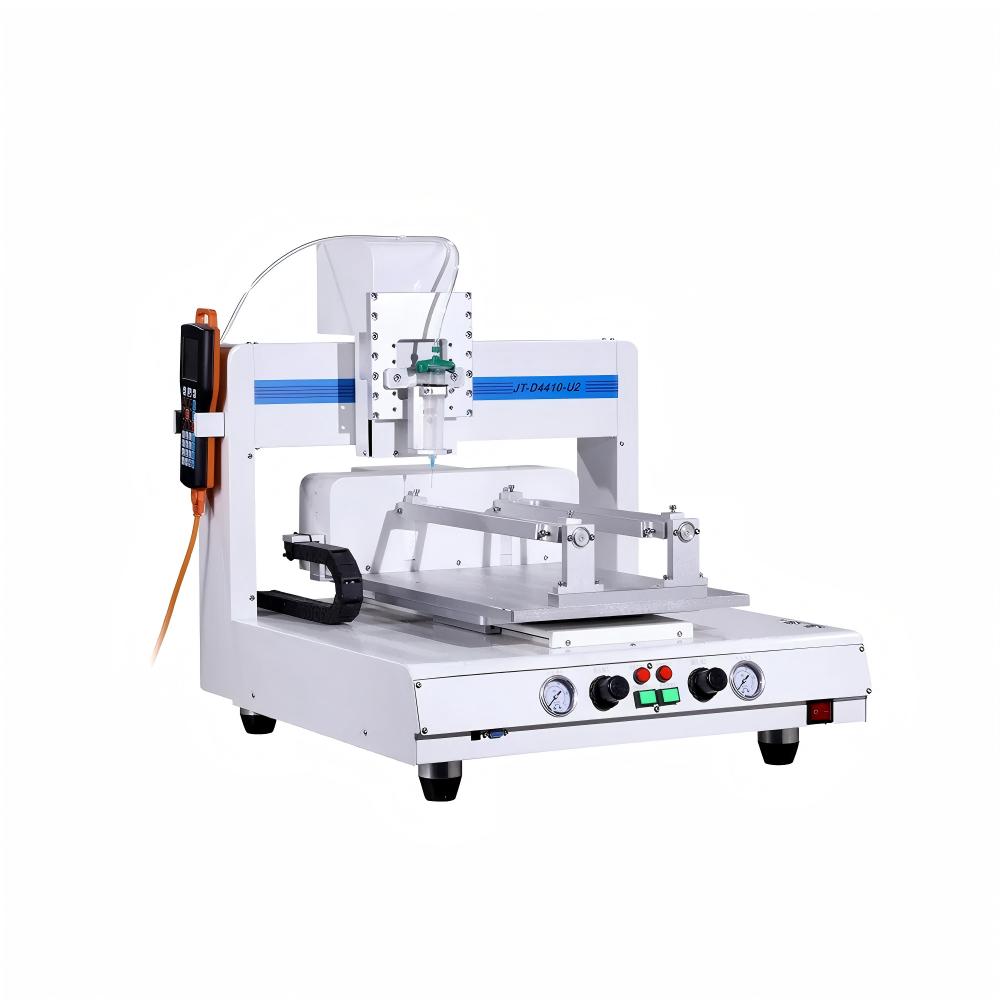
Spec sheets tend to highlight what a machine can do under ideal conditions, but that tells you little about how it will behave at 2 a.m. when a sensor blinks out or a part arrives slightly misaligned. Automation readiness shows up in the corners: the default timeout values, the quality of the alarm text, the way the controller pauses instead of crashing. If you can't interrogate those states without a proprietary dongle, the integration cost will swallow any promised speed advantage.
You also want to see whether the system treats changeover as a first-class workflow. Being able to store and recall recipes is table stakes; the differentiator is how many manual touchpoints remain after recall. Check that offsets, tool data, and communication settings all come back in one shot. If an operator has to re-teach three axes or re-sync a barcode reader every time, the machine is not honestly ready for unattended automation.
Material interfaces matter just as much as software. Watch a physical demo with your own fixtures if you can: how long does it take to align the infeed, where do chips or dust collect, how easy is it to reach a jammed part? These mechanical details often dictate uptime more than the top speed on page one of the brochure.
Vetting Suppliers for Long-Haul Reliability
Long-haul reliability starts long before a contract is signed. We ask suppliers to walk us through a specific failure they experienced on a route over 3,000 kilometers—what broke, how they caught it, and what changed afterward. If they can't point to a real incident and a concrete fix, that's a red flag. We also look at their maintenance logs from the last eighteen months, not just the polished summary. Average repair turnaround time, parts availability in remote depots, and how often they swap out drivers mid-route tell you more than any brochure.
Then we test them with a live trial that includes at least two border crossings and one segment with poor road conditions. We deliberately don't share our usual lane data; we want to see how their dispatch handles ambiguity, weather delays, and last-minute paperwork. A reliable partner will push back with realistic timelines instead of promising impossible arrival windows. We also interview their longest-serving drivers, because they know which equipment tends to fail after 15,000 kilometers and which depots actually stock spare parts.
Finally, we review their financials with an eye toward cash flow, not just profit margin. A supplier running on thin liquidity will cut corners on tire replacement or postpone engine overhauls, and that shows up on the road six months later. We prefer partners who own their own maintenance facilities or have fixed contracts with local repair shops along their core corridors. If they can't show us a preventive replacement schedule tied to odometer readings, we walk away.
The Real Cost of Ownership Nobody Puts on a Quote
The sticker price is only the opening act. What follows is a quiet parade of expenses that never make it onto the glossy brochure: the battery replacement at year three, the software subscription you didn't know was optional, the specialized tires that wear out twice as fast, the insurance premium adjusted for a repair cost you won't see until the first fender bender. None of these appear on the quote, but they all appear on your bank statement. Ownership is not a single purchase; it's a relationship with a long memory.
Most buyers do the math on fuel and oil changes, then stop. But the real cost hides in depreciation curves that bend sharply after the warranty expires, in labor rates that jump once your car is out of the free-service window, in the diagnostic fees charged just to hear a mechanic say "we'll need to keep it overnight." This is where the advertised price becomes a distant memory and the monthly reality sets in. A car that looks cheap on paper can quietly become the most expensive thing you own without ever leaving the driveway in style.
It's not about avoiding every hidden cost—that's impossible. It's about walking in with your eyes open, asking the questions that salespeople don't volunteer, and budgeting for the ownership you'll actually have, not the one on the window sticker. Because the true cost isn't on the quote. It's in the years after you drive off the lot.
Customization Without the Custom Price Tag
Most brands treat customization like a luxury add-on, reserved for clients with deep pockets and patient timelines. We flipped that assumption on its head. Our approach strips away the bloated overhead that usually inflates bespoke work, letting you tweak layouts, swap components, and adjust functionality without a single line of surprise billing. You get the flexibility of a tailored build with the predictability of a fixed scope.
The secret isn't magic—it's modular design and a lean production process. Instead of starting from zero every time, we assemble from a library of proven, flexible blocks, then fine-tune the details that matter to you. That means faster turnarounds, fewer revision cycles, and no premium charged for simply wanting something that actually fits your workflow. Your budget stays grounded while the result feels anything but off-the-shelf.
So whether you need a subtle tweak or a full visual re-skin, you won't have to choose between personalization and affordability. It's customization that respects your vision and your bottom line—without making you pay for the privilege.
After-Sales Support That Keeps Lines Moving
When a critical machine goes down, every minute of idle time chips away at your throughput. Our after-sales support is built around a single idea: get you back to full speed before the backlog builds. From remote diagnostics that often resolve issues without a site visit to a regional parts network stocked with high-wear components, the response is measured in hours, not days. The team tracks your equipment’s service history so repeat problems are addressed at the root instead of patched on the fly.
What makes the difference is the way support is structured around your production calendar. You can schedule preventive inspections during planned slowdowns, and if something unexpected happens, a dedicated engineer who already knows your line picks up the call. Spare parts ship from the nearest hub with clear installation guidance, so your own maintenance crew can often handle the fix without waiting for a technician. That kind of flexibility keeps small issues from turning into full stoppages.
The result is less firefighting and more predictable output. Operators aren’t left guessing about error codes or waiting on hold while orders stack up. Instead, they have a direct line to people who understand the equipment and the pressure of a tight production window. It’s after-sales support that doesn’t just respond to problems—it actively protects the rhythm of your operation.
FAQ
Start with the adhesive range the machine can handle, not just the price per unit. A dispenser that struggles with your actual viscosity spectrum will create more downtime than any upfront savings. Ask for video of the unit running a material similar to yours, and check whether the wetting parts resist abrasion from filled or reactive adhesives.
Electric systems usually win when you need programmable shot sizes and rapid changeovers between different bead profiles. Pneumatic equipment can still make sense for simple, consistent dots in a low-variety line. Look at your batch records: if you are adjusting air pressure more than twice a shift, the precision of an electric drive will pay for itself quickly.
The nozzle controls fluid dynamics at the point of deposit. A poorly matched nozzle causes tailing, stringing, or inconsistent bead width even on a fast machine. Before upgrading the whole platform, test tapered, stainless, and coated nozzle geometries with your actual adhesive. Often a $30 nozzle change fixes what a $30,000 speed upgrade cannot.
Beyond the unit price, look at spare parts lead times, the cost of proprietary cartridges, energy consumption for heated dispensing, and the labor needed to recalibrate after material changes. Some machines require factory-trained technicians for basic repairs, which can erase any volume discount. Request a two-year total cost estimate from the supplier, not just a quote sheet.
Run a controlled trial with your own adhesive, your own substrate, and your own operator. Ask for a loaner or rent a demo unit for at least three production days. Measure first-pass yield and reject rate against your current process. If a supplier refuses a trial or only offers a short lab demo, treat that as a sign their machine may not survive your floor conditions.
Choose modular when your product mix changes seasonally or you expect to add new adhesives within two years. A dedicated unit is cheaper and simpler, but it becomes obsolete the moment your line shifts. Modular systems let you swap valves, controllers, and reservoirs without replacing the entire frame, which matters for manufacturers who value capital efficiency over lowest initial cost.
Clean the fluid path at the end of every shift, not just weekly. For moisture-curing adhesives, purge with a compatible solvent and cap the nozzle. Check valve seals and O-rings for swelling every 200 hours. Keep a log of pressure drift, because rising pressure often signals a clogged filter or a worn valve seat before a full failure occurs.
Viscosity shifts with temperature, batch age, and filler settling. This changes flow rate even if the machine settings stay identical. Buyers should look for machines with closed-loop pressure monitoring or temperature-controlled reservoirs. If your adhesive varies by more than 10% in viscosity across a shift, a dispenser without feedback will produce drifting bead sizes and rejected parts.
Conclusion
Smart manufacturers know that buying a glue dispensing machine isn't about chasing the highest precision spec on a datasheet. It's about matching real tolerances to the messiest parts of your production floor—temperature swings, operator variance, and mixed material lots. If your line only needs ±0.2 mm repeatability, paying for a lab-grade ±0.01 mm system just adds calibration headaches. Look instead for machines that hold tolerance under continuous duty cycles and document their drift over an eight-hour shift. Automation readiness matters less about robots and more about whether the controller speaks your plant's language—discrete I/O, fieldbus, or simple recipe recall—so a technician can swap jobs in minutes instead of calling an integrator.
Vetting suppliers means asking for three reference lines running the same adhesive, not just a polished demo video. Long-haul reliability shows up in valve seat materials, pump rebuild intervals, and how the company handles a midnight breakdown. The real cost of ownership hides in nozzle wear, purging waste, and compressed air consumption—numbers nobody puts on a quote but everyone feels in monthly overhead. Smart buyers demand a dispense head that can be reconfigured for dot, bead, or spray without a five-figure engineering charge. And after-sales support isn't a phone number; it's a local service stock, remote diagnostics, and a promised four-hour response window that gets written into the purchase order. That's how you keep lines moving instead of waiting on a courier.
Contact Us
Contact Person: Volien
Email: [email protected]
Tel/WhatsApp: +86 18029161762
Website: https://www.jatentech.com/