

China Motor Magnet: Key Factors for Choosing High-Performance Magnets
2026-08-14
The performance of a motor often hinges on one unsung hero: the permanent magnet. For engineers sourcing China motor magnets, separating the exceptional from the merely adequate requires a sharp focus on a few critical factors. DAWA has spent years refining its approach to these factors, and in this post, we’ll break down what truly matters.
What Magnet Grade Actually Tells You About Real-World Performance
Magnet grades like N35 or N52 are often mistaken for a simple power rating, but they actually describe a narrow slice of material behavior under ideal lab conditions. The letter and number refer to the maximum energy product — essentially how much magnetic force can be packed into a given volume when fully magnetized at room temperature. What they don't tell you is how that magnet will behave inside your motor, sensor, or mounting bracket once heat, demagnetizing fields, or mechanical stress enter the picture. A high grade doesn't automatically mean better performance; it means the material starts with a higher ceiling, but real-world conditions frequently shave that ceiling down before you ever measure the final output.
The gap between the spec sheet and the installed magnet widens quickly as temperature climbs. Standard neodymium grades lose strength rapidly above 80¬∞C, and even high-temperature variants like N42SH or N48H are only rated for specific operating windows. If your application runs hot, a lower grade with a higher coercivity rating can easily outperform a higher grade that's already past its knee point. Similarly, if the magnet sits near steel or other magnets, the demagnetizing field can knock a few points off the working flux density — something the grade alone never reveals. That's why experienced engineers look at the full BH curve at operating temperature, not just the two characters printed on the label.
So what does the grade actually tell you? It gives you a starting point for material selection and a rough comparison between magnets of the same family. It tells you the theoretical maximum energy product under reference conditions, which can guide size and shape decisions early in a design. But it says nothing about coating durability, corrosion resistance, mechanical brittleness, or how the magnet behaves after repeated thermal cycling. Real-world performance is a product of grade plus geometry plus environment — and if you ignore any one of those, the grade alone will mislead you every time.
Temperature Limits and Demagnetization Risks in Motor Design
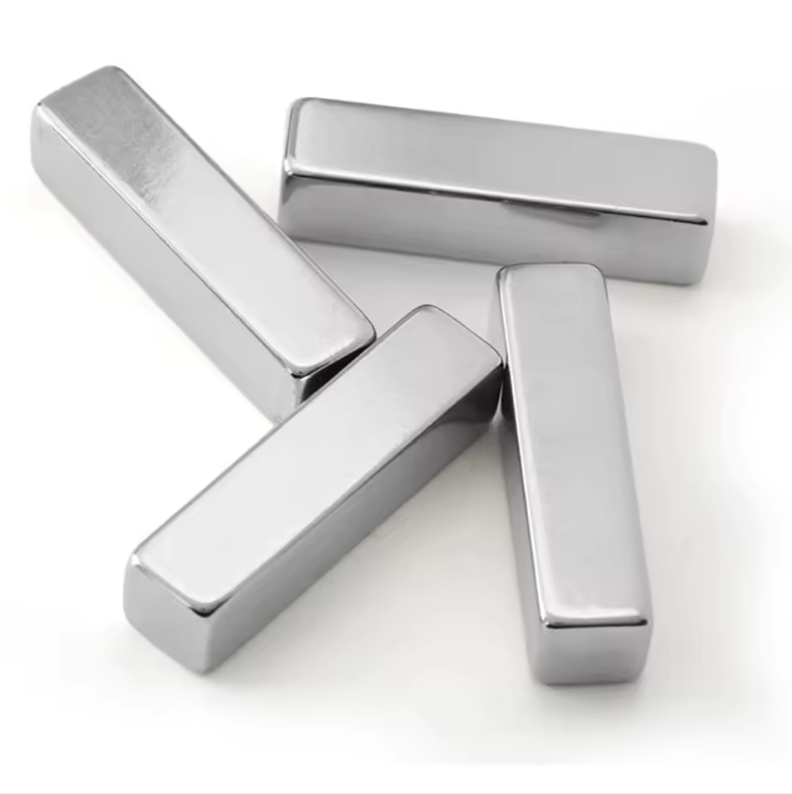
Permanent magnets in high-performance motors operate near their thermal thresholds, where even brief excursions beyond rated temperature can trigger irreversible flux loss. NdFeB grades, for instance, often have a maximum operating temperature between 80°C and 220°C depending on coercivity and coating, but localized hot spots in stator windings can push rotor surfaces past this limit. Designers must therefore factor in both average temperature rise and transient peaks caused by overloads, high ambient conditions, or poor ventilation.
Demagnetization occurs not only from heat alone but from the combined stress of elevated temperature and strong opposing fields produced by stator currents during field-weakening or fault conditions. A magnet that survives a 150°C bake in free air may lose significant magnetization when simultaneously subjected to a reverse field of several hundred kA/m. This is why motor engineers rely on knee-point curves rather than just Curie temperature, plotting flux density versus demagnetizing field at specific temperatures to ensure the operating point never crosses the irreversible threshold.
Mitigation strategies include selecting grades with higher intrinsic coercivity, adding thermal barriers between stator and rotor, implementing active cooling channels, and derating the motor controller to limit peak phase current. Permanent magnet motors used in electric vehicles often embed temperature sensors in the end windings and adjust torque limits in real time, sacrificing short-term performance to avoid long-term rotor damage. Without such safeguards, a single overheating event can reduce torque output permanently, even if the motor continues to spin normally.
Protective Coatings That Extend Magnet Life in Harsh Conditions
Neodymium magnets are notoriously vulnerable once moisture, salt spray, or acidic fumes get through the surface. A bare NdFeB magnet can start pitting within hours in a coastal setting, which quietly eats away at the magnetic mass and invites hydrogen to penetrate the grain boundaries. This is exactly where a well-chosen coating changes the economics. Instead of replacing magnets every season, operators use nickel, zinc, or epoxy layers to block the corrosive path before it begins. The coating does not need to be thick; it needs to be continuous, well-bonded, and matched to the specific exposure.
Different environments call for different barriers. Nickel plating works well in many indoor and lightly humid applications, but it can develop microcracks under thermal cycling or repeated impact. For saltwater or continuous immersion, epoxy or PTFE-based coatings tend to hold up longer because they resist water uptake and chemical attack. Parylene, applied as a vapor, offers an ultra-thin, pinhole-free layer that follows complex magnet shapes without building up on edges. In aggressive acid or alkaline conditions, multi-layer systems such as copper-nickel-epoxy combine the best properties of each material and can extend service life by several times compared with a single coating.
The application process matters as much as the coating itself. Magnets must be cleaned, passivated, and sometimes pre-treated so the coating adheres to the surface rather than sitting on top of oxide dust. Poor adhesion leads to flaking at edges, where corrosion starts first. A high-quality coating line includes inspection for pinholes and thickness variation, because even a tiny breach can act as a corrosion cell. In practice, the right coating plus careful surface preparation often turns a magnet that would fail in months into one that lasts years under the same harsh conditions.
How Dimensional Tolerance Affects Motor Efficiency and Noise
Dimensional tolerance rarely shows up as a dramatic failure, but it quietly reshapes the magnetic gap between rotor and stator. When bore roundness or shaft concentricity drifts even a few microns from nominal, the air gap becomes uneven around the circumference. That imbalance creates a repeating magnetic pull that shows up as torque ripple and vibration. The motor doesn't just lose a fraction of a percentage point in efficiency; it often develops a tonal whine that grows louder under load. Machinists who chase tight roundness and true running surfaces aren't being fussy without reason, the motor's acoustic signature and wattage draw both reflect that geometry.
Bearing seats and housing fits are another area where tolerance choices get loud. A shaft journal cut toward the minimum material condition can leave too much internal clearance, letting the rotor orbit slightly and rub energy away as heat. Go the other way and the interference fit can preload the bearing, increasing drag and shortening grease life. Housings that come out slightly oval or have poor perpendicularity force the outer ring into a non-uniform contact pattern, which produces a low-frequency rumble at certain speeds. The difference between a quiet, efficient motor and one that hums and runs warm is often hidden in these sub-millimeter choices.
Stack-up across multiple parts matters just as much as any single dimension. End play, lamination alignment, and frame bore depth all interact to position the rotor axially relative to the stator's magnetic center. When that position shifts, stray flux and axial thrust increase, consuming extra current while adding vibration at twice line frequency. Selective assembly and tighter control on only the features that affect alignment can recover most of the loss without making every dimension expensive. Over-tightening everything, however, raises cost and makes the motor harder to build, so the real skill lies in knowing which tolerances actually reach the air gap and which ones only matter on paper.
Vetting Chinese Magnet Suppliers Beyond the Initial Sample
Initial samples from Chinese magnet suppliers can be dangerously misleading. A hand-picked piece or a small batch run under a manager’s eye rarely represents what comes off a high-volume line. Instead of trusting the sample, ask for batch-to-batch variation data on key parameters like Br, Hc, and maximum energy product. Also drill into raw material sourcing—cheap neodymium or recycled ferrite can cause gradual performance drift that no single sample will reveal.
After paperwork, insist on a pilot run of 200 to 500 pieces under normal production conditions. Compare those units against the original sample using a pre-agreed inspection checklist. Look beyond final dimensions: ask how often the supplier calibrates their gauss meters and whether they test coating adhesion and salt spray resistance. Request unedited video of the actual magnetizing and plating lines, not marketing footage. If budget allows, send a local third-party inspector for an unannounced visit during the pilot run.
Long-term reliability hinges on how a supplier reacts when things go wrong. Ask for a real example of a corrective action report—not a blank template. Check if they maintain SPC charts and share them without hesitation. A supplier that hides traceability records or resists audits is often covering up inconsistent raw materials or outdated presses. Price matters, but a slightly cheaper magnet that loses 15% of its flux after six months will cost far more than a thorough vetting process ever would.
Custom Magnet Geometries: When Off-the-Shelf Won't Cut It
Standard magnet catalogs are built around a handful of familiar shapes: discs, rings, blocks, and sometimes spheres. But real design constraints rarely line up with those defaults. A torque sensor might need a ring with a tapered inner profile to hug a rotating shaft, or a magnetic coupling could call for an arc segment with a single flat face to prevent slip. When the available geometry forces you to compromise on air gap, mounting, or flux path, a custom shape stops being a luxury and becomes the only way to meet the spec.
The tricky part is that geometry and material behavior are not independent. Sharp internal corners on a sintered NdFeB magnet, for instance, are prime spots for cracking during the pressing or magnetization stages. Very thin walls can survive in a CAD model but fail in the furnace because they cannot hold their shape. Working out these details early with a magnet supplier is far cheaper than discovering a yield issue after tooling is made. Often a tiny radius, a slight draft angle, or a change in segmenting the part resolves the problem without weakening the field.
Manufacturing route also sets the actual geometric freedom. Pressed and sintered magnets favor simple, near-net shapes with tight tolerances possible through grinding. Bonded magnets, by contrast, can be injection molded into intricate forms with clips, locating features, or overmolded shafts, though the magnetic output is lower. For prototyping or small batches, wire EDM or abrasive waterjet cutting from a stock block gives you a custom profile in days. The right geometry is the one that balances magnetic performance, mechanical integrity, and what a given process can realistically deliver.
FAQ
For high-speed motors, the magnet needs a strong resistance to demagnetization because elevated RPMs create strong opposing fields. Grades like N38SH or N42SH with higher intrinsic coercivity (Hcj) are typical, as they hold their magnetization better under heat and reverse fields than standard N35.
Neodymium offers the highest energy product per unit volume among commercial magnet materials, so a smaller magnet can deliver the same torque as a much larger ferrite or AlNiCo part. That directly enables lighter, smaller motor designs without sacrificing output.
Coercivity is a make-or-break parameter. A magnet with low coercivity may look fine on paper but will partially demagnetize under load, especially in brushless DC or servo motors. For motors that run warm, you want at least an SH or UH grade to keep the operating point safe.
Temperature ratings tell you the maximum working temperature before irreversible losses become significant. A standard N-grade neodymium magnet can lose strength above 80°C, while SH grades work up to around 150°C and UH grades up to 180°C. Matching the magnet grade to the motor's worst-case winding temperature prevents gradual torque loss.
Nickel-copper-nickel multilayer coating is the most common because it protects against corrosion and provides a clean surface for adhesive bonding. Epoxy and zinc coatings are also used, especially for cost-sensitive or unusual shapes. Without a proper coating, neodymium magnets oxidize quickly in humid environments and shed magnetic particles.
Samarium cobalt costs more and has a lower energy product than top neodymium grades, but it offers superior thermal stability and inherent corrosion resistance. That makes it the better choice for aerospace, oil drilling, or high-temperature industrial motors where peak temperatures exceed 180-200°C or where coating failure would be catastrophic.
Even a few hundredths of a millimeter variation in magnet thickness or arc radius can change the air gap and produce cogging or efficiency losses. Chinese manufacturers with in-house grinding and automated sorting can hold tight tolerances, which translates into consistent back EMF and smoother torque output across a production batch.
Ask for full BH curve data, not just the grade label, because remanence and coercivity vary within a grade. Also request batch-level test reports, coating thickness measurements, and samples for thermal cycling tests. A supplier that can provide this documentation and answer detailed technical questions is usually more reliable than one that only quotes price.
Conclusion
Understanding what a magnet grade actually means in real motor conditions is often more nuanced than comparing N35 versus N52 on paper. A higher grade doesn't automatically translate to better field strength once temperature, operating point, and load dynamics come into play. Many Chinese motor magnets are specified at room temperature, but real demagnetization risks appear under sustained heat or sudden current spikes. That's why smart buyers look at the full demagnetization curve, not just Br max. Coatings like nickel-copper-nickel, epoxy, or even Parylene become non-negotiable if the motor runs in humid, salty, or chemically aggressive environments. Without proper protection, even a top-grade magnet can corrode and lose structural integrity surprisingly fast.
Dimensional tolerance is another hidden variable. A magnet that's off by a few tenths of a millimeter can increase air gap variation, leading to cogging torque, noise, and efficiency loss in finished motors. Rather than relying on a single sample, experienced engineers audit how a Chinese supplier controls consistency across batches—grinding, chamfering, and sorting processes matter just as much as the initial spec sheet. When standard shapes can't deliver the flux distribution you need, custom geometries like skewed arcs, bread-loaf segments, or radial rings are worth the tooling investment, provided the supplier has real in-house machining and magnetic simulation capability, not just trading capacity.
Contact Us
Contact Person: Kelvin Lo
Email: [email protected]
Tel/WhatsApp: 0769-88561131
Website: https://dawamagnetic.com/