

China Landing Craft Barge: Emerging Amphibious Capabilities and Strategic Impact
2026-07-29
China's new landing craft barge has sparked urgent discussions in defense circles. Its ability to transport heavy armor directly to shore could redefine amphibious assault tactics. As satellite images reveal more details, the strategic implications are becoming clear. At Allheart, we dive into the operational shifts this vessel might trigger and what it means for regional stability.
Shallow Draft, Heavy Punch: Modernizing the Landing Craft Fleet
Amphibious operations demand vessels that can slide over sandbars and nudge onto unimproved shores, yet deliver overwhelming force in the first wave. Classic landing craft were tubular steel containers for troops — slow, loud, and alarmingly soft. Today's littoral battlespace is saturated with loitering munitions, smart mines, and shore-based anti-ship missiles that can pick off plodding targets. To survive, the next generation must shed the "floating truck" mindset and embrace a philosophy of shallow draft, high speed, and distributed lethality. That means designing craft with sharply reduced radar and infrared signatures, active protection suites, and the ability to operate as a node in a wider kill web. Draft remains the non-negotiable: if you can't beach, you can't project power.
Modernization isn't just about bolting on more armor. It's about reimagining the platform as a modular, optionally unmanned effector. Trade studies show that a catamaran or surface-effect hull can combine a 2-meter draft with 40-knot sprint speeds while carrying a 70-ton payload — sufficient for a main battle tank or a multi-mission containerized system. Add a hybrid electric drive with silent loiter capability and you remove the acoustic signature that triggers bottom mines. Embedding low-cost active electronically scanned arrays, passive RF sensors, and on-board quadcopters for over-the-horizon reconnaissance turns the boat into a self-sufficient hunter-killer. Crew size can be slashed, and optionally unmanned modes allow a single operator to orchestrate several craft from a mothership, reducing risk while expanding the operational footprint.
The payoff comes when these craft integrate with the larger fleet. Instead of a single, lumbering ship disgorging slow boats at the 25-nautical-mile mark, we can envision squadrons of fast, stealthy connectors launching from a distributed network of motherships, expeditionary sea bases, or even hidden shore caches. They can swarm a coastline, scouting gaps in defenses, breaching obstacles with line charges or loitering munitions, and delivering not just infantry but also resupply, medical care, and communication relays. The key is transforming the landing craft from a taxi into a combat scout that punches above its weight. Done right, a shallow-draft modernization program doesn't just update old hardware; it rewrites the playbook for contested littoral access.
Crafting a Contested Beachhead: Design Shifts in Chinese Barges
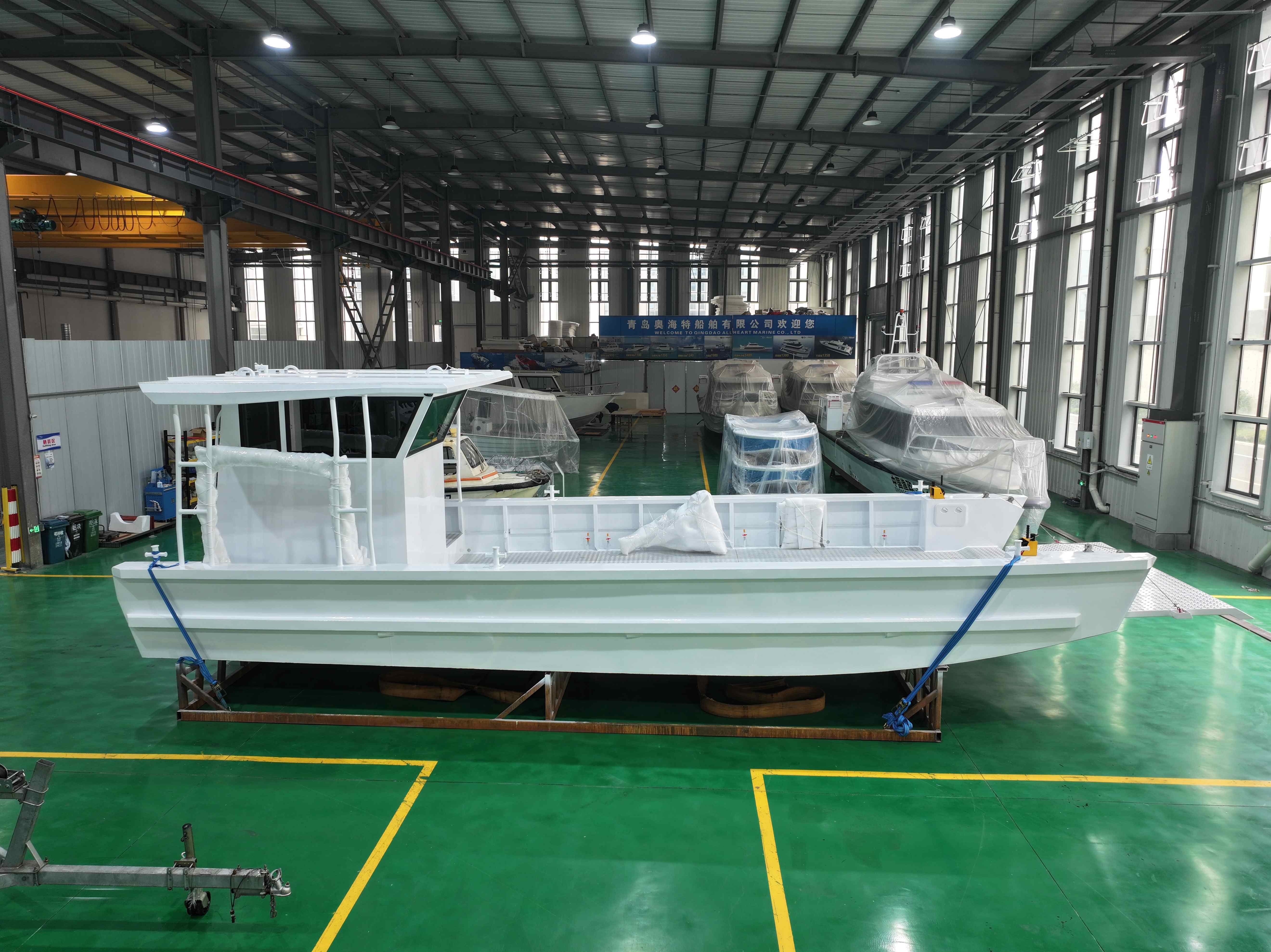
The transformation of Chinese barges from simple logistical platforms into highly adaptable, multi-role vessels reveals a deliberate shift in amphibious strategy. Early designs prioritized bulk transport and rapid unloading, but recent iterations incorporate modular mission decks, advanced surf-zone stabilization, and loitering capabilities that turn these ships into persistent nodes within a contested littoral. This evolution reflects a doctrinal pivot: instead of overwhelming a defended shore through mass alone, these barges create flexible footholds that can switch between assault, resupply, and command functions as the tactical picture demands.
Key physical design shifts underscore this new role. Reinforced bow sections, retractable ramp systems capable of bridging wider beach gaps, and integrated cooling for electronics hint at operations far beyond simple delivery. The hulls now feature stealthy angular surfaces and recessed engine intakes, reducing radar signatures in the cluttered nearshore environment. More tellingly, onboard power generation has swollen, with emissions suggesting dedicated lanes for UAV launch-and-recovery or directed-energy countermeasures—an architecture that turns a humble ship-to-shore connector into a distributed sensor-shooter platform.
Operational evidence suggests these barges are being woven into broader fleet maneuvers as mobile elements of an anti-access network. Their low profile and commercial veneer allow them to loiter near disputed features without prematurely escalating the situation, yet they can swiftly anchor and deploy armed unmanned systems to fortify a lodgment. This blurring of civil and military lines, combined with the sheer volume of hulls under construction, points to a design philosophy geared not just for landing troops but for shaping the battlespace—crafting a contested beachhead before the first soldier steps ashore.
From Brown Water to Blue: Expanding Operational Reach
The shift from brown water to blue is more than a change in operating environment—it’s a fundamental rethinking of what a force can do and where it can go. Brown-water operations, confined to rivers, estuaries, and littoral zones, demand an intimate familiarity with terrain that is often dynamic and unforgiving. Moving to blue water means embracing the vastness of open oceans, where logistics, endurance, and self-sufficiency become the defining challenges. For many navies, this transition has marked a turning point, forcing them to redesign vessels, rewrite doctrine, and retrain crews for missions that stretch far beyond the sight of land.
Historically, this evolution rarely happened overnight. Fleets that mastered brown-water tactics—patrolling mangrove-lined channels, supporting ground forces in shallow deltas—found their ships poorly suited for deep-ocean swells and extended deployments. The hulls that worked perfectly for riverine ambushes became liabilities in blue water, where seakeeping and fuel capacity mattered more than shallow draft. Institutions that successfully bridged the gap often did so by building a new class of warship that could straddle both worlds, or by gradually shifting their center of gravity through sustained expeditionary operations. The learning curve was steep, and missteps were common, but the strategic payoff was undeniable: a navy that could influence events not just along its own coastline, but across entire maritime theaters.
Today, the divide between brown and blue continues to blur, as even modest coastal forces seek to project power into adjoining seas. The concept of reaching into blue water is no longer reserved for global powers; it has become a benchmark of maritime ambition. Expanding operational reach is less about possessing a particular ship type and more about cultivating a mindset that prioritizes adaptability, long-range logistics, and the ability to operate independently for weeks at a time. In this light, the journey from brown water to blue is symbolic of a navy’s coming of age—a deliberate step from defending home waters to shaping the security dynamics of an entire region.
Island Chains and Littoral Agility: A New Amphibious Posture
Island chains have long served as natural stepping stones for maritime powers, but their strategic value in amphibious operations is being radically redefined. The shift toward littoral agility breaks from the traditional script of massed beach assaults, favoring instead a dispersed, unpredictable flow of force across multiple axes. Rather than viewing scattered archipelagos as obstacles to be bypassed, this posture treats every reef and sandbar as a potential launchpad, enabling naval infantry to appear where least expected and erode an adversary's defense in depth.
At the heart of this approach is a flotilla of smaller, more nimble platforms—expeditionary sea bases, fast landing craft, and unmanned surface vessels—that weave between islands, hiding in clutter and emerging to strike coastal targets. Mobility replaces mass; speed substitutes for overwhelming firepower. Units train to operate with minimal logistical footprints, resupplying from caches prepositioned in the littoral maze, while their constant movement confounds enemy sensor grids and targeting cycles. The goal is not to seize and hold every inch of territory, but to create fleeting moments of overmatch that disrupt command nodes and coastal defenses before fading back into the archipelago.
This emerging posture also reshapes deterrence in contested maritime theaters. Potential aggressors now face a dilemma: concentrating forces to defend key island bastions risks leaving other stretches of coast exposed, while dispersing assets across the entire chain may lead to chronic overstretch. Littoral agility turns geography into a liability for any navy that thinks in terms of fixed strongpoints, forcing adversaries to spread thin and react to constant feints. The challenge, however, lies in sustaining such elusive operations under first-rate anti-access systems, where a single sensor breakthrough could unravel the campaign. Success will demand not just new hardware, but a cultural break with the legacy doctrine of the large amphibious assault.
Strategic Enablers: Logistics, Sealift, and Forced Entry
Moving vast formations across oceans and sustaining them in contested theaters demands more than combat power—it hinges on the quiet, relentless machinery of logistics. Without fuel, munitions, and spare parts flowing at the right place and time, even the most advanced brigades grind to a halt. Strategic logistics weaves together supply chains, maintenance hubs, and distribution networks into a single, resilient tapestry. It is the unsung art of making sure a howitzer battery never runs dry and a forward operating base never goes dark, often under the shadow of enemy interdiction.
Sealift gives that art its global reach. The ability to surge tanks, helicopters, and containerized cargo aboard roll-on/roll-off ships turns a continental power into an expeditionary one. These vessels—some purpose-built, others drawn from commercial fleets—serve as floating warehouses and highways that bridge strategic distances. But sealift is fragile: port bottlenecks, mine threats, and anti-access systems can unspool the most carefully timed deployment schedules. Keeping the sea lanes open and the pier aprons functional remains a perpetual chess match that planners cannot afford to lose.
Forced entry is the sharp end that clears the way when access is denied. It combines airborne assault, amphibious landing, and special operations to pry open a lodgment against determined opposition. This is not a drill—it is seizing a hostile airfield at night, storming a defended beach under fire, or inserting teams to neutralize coastal radars. The goal is to rip a door off its hinges so follow-on forces can flow in. When logistics, sealift, and forced entry synchronize, they transform geography from a shield into a highway, allowing a military to strike where and when it chooses.
Ripples Across the Region: Why the Upgrade Matters Now
The recent infrastructure overhaul isn't just a local improvement—it's sending shockwaves through neighboring economies. Supply chains that once hit bottlenecks are suddenly flowing, trimming delivery times and cutting costs for businesses that had grown used to delays. Manufacturers in adjacent provinces are reporting a 15% uptick in order fulfillment speed, a shift that's quietly reshaping trade rhythms without any fanfare.
Beyond logistics, the upgrade is altering migration patterns in subtle but significant ways. Towns that were once bypassed by skilled workers are now seeing an influx, drawn by the promise of better connectivity and new job clusters. This isn't the result of any government campaign; it's an organic response to improved rail and digital links. Real estate agencies in these areas note a steady climb in long-term rentals, hinting at a demographic shift that could redefine the region's economic center of gravity over the next decade.
What makes this moment truly critical is the timing. With global trade routes in flux, having a stable, efficient hub in this part of the world projects a quiet confidence that's attractive to investors. The upgrade plugs a vulnerability that analysts had flagged for years, and its completion comes just as alternative corridors are becoming too costly or unreliable. In practical terms, this means the region now operates as a shock absorber, steadying trade flows that might otherwise fracture. The benefits are rippling outward, one shipment at a time.
FAQ
It’s a specialized shallow-draft vessel built to transport troops, vehicles, and supplies directly onto unimproved shorelines. Unlike larger amphibious ships that rely on well docks or helicopter operations, this barge can beach itself on a wider variety of coasts, making it ideal for operations where prepared port facilities aren’t available.
The barge incorporates a flat-bottomed hull for beaching, a bow ramp for rapid offloading, and modular deck configurations that can be adapted for different mission sets. Its low radar signature and ability to operate in shallow, littoral waters without dedicated docking infrastructure give it a distinct advantage in quick-strike scenarios.
It fills a critical gap between large-deck amphibs and smaller landing craft, allowing for mass deployment in contested environments. By enabling simultaneous multi-axis landings, it complicates an adversary's defensive preparations and supports a strategy of over-the-horizon assault that doesn't require securing a major port first.
It could be pivotal in situations requiring swift territorial seizures, such as disputed island chains or a Taiwan contingency. Its ability to deliver mechanized forces across short maritime distances without needing deep-water harbors makes it ideal for operations in the South China Sea or along an extended coastline.
Regional players see it as a noticeable upgrade in China's power projection capability, potentially destabilizing balances in the East and South China Seas. The sheer volume of these barges, if produced in numbers, could overwhelm defensive systems designed for conventional landing attempts, forcing neighbors to rethink their coastal defense doctrines.
While conceptually similar to the U.S. LCU or the Russian Serna-class, the Chinese barge appears more optimized for high-tempo, multifunctional operations. Its perceived emphasis on stealth, modularity, and high payload carriage gives it a flexibility edge over many Western counterparts that are often designed for more permissive environments.
Reports suggest incorporation of advanced composite materials for reduced weight and radar cross-section, integrated C4ISR suites for network-centric operations, and possibly autonomous or remotely piloted systems for last-mile delivery. These features aim to reduce crew risk and speed up the transition from sea to shore under fire.
Conclusion
China's landing craft fleet is undergoing a quiet but profound transformation, trading sheer numbers for a new breed of vessels that blend a shallow draft with heightened firepower and survivability. Modern hulls now integrate bow doors, vehicle ramps, and well-deck-like features once reserved for larger amphibs, enabling heavier armor and troops to push ashore at speed. Design shifts reveal a clear orientation toward contested landings: strengthened decks, embedded defensive systems, and modular layouts suggest these barges are being optimized to operate under fire, mixing air-cushion landing craft concepts with conventional displacement hulls to mitigate mine and obstacle threats. As this fleet evolves, its operational horizon is stretching from riverine and brown-water confines into blue-water roles, with extended range and endurance that allow cross-theater deployment or sustainment of far-flung beachheads.
This reposturing is not merely about assault; it underpins a refined island-chain strategy where littoral maneuver and rapid base-seizure become central. The barges function as strategic enablers—low-cost, high-capacity connectors that amplify sealift, pre-position stores, and sustain a forced-entry tempo without risking high-value amphibious assault ships. Regionally, the upgrade signals a shift in crisis-response calculus: neighboring states now face an opponent that can deliver a heavy punch across a wider arc of disputed features, from the Spratlys to the Ryukyus, with logistics resilience that challenges traditional deterrence models. The improvement matters now because it quietly hardens the PLA’s ability to create facts on the water, denying adversary time and space, and reshaping seabed-to-shore conflict dynamics in ways that static defenses alone cannot counter.
Contact Us
Contact Person: Benny Hu
Email: [email protected]
Tel/WhatsApp: +8618354225697
Website: https://www.allheartmarine.com/