
China Cleaning Furnace Technology: Advanced Solutions for Industrial Thermal Cleaning
2026-08-18
As industrial thermal cleaning demands become more precise, many manufacturers are turning to China for cleaning furnace technology that balances performance with cost-efficiency. At the forefront of this shift is THINKING-LONG, whose advanced solutions are quietly redefining how complex residues are removed from tooling and components. But what exactly sets these furnaces apart in a crowded market? The answer lies in a blend of thermal control, safety engineering, and a willingness to adapt to niche production challenges.
The Quiet Rise of China's Thermal Cleaning Equipment
For years, European and American brands dominated industrial thermal cleaning, but a quiet shift has been underway in China. Domestic manufacturers began not with flashy product launches, but by solving stubborn problems for local mold makers and coating lines—removing cured polymers from dies, stripping paint from jigs, and reclaiming parts without abrasive damage. These early systems were often utilitarian, built around insulated chambers, precise ramp-and-soak controls, and gas or electric heating elements. They rarely made headlines, yet they spread through word of mouth in industrial parks across Jiangsu, Guangdong, and Zhejiang.
What changed is less about a single breakthrough than a steady accumulation of process know-how. Chinese suppliers started pairing thermal cleaning units with afterburners and fume scrubbing to meet tightening local emissions rules, something many older imported systems lacked. They also moved into fluidized bed cleaning and vacuum pyrolysis, tailoring chamber sizes to mid-sized workshops that foreign vendors often overlooked. The result is a growing class of equipment that matches much of the performance of established brands at a fraction of the lead time and cost—built for plants that need to clean molds every day, not just during annual maintenance.
That quiet rise now shows up in unlikely places: Southeast Asian plastics processors running Chinese thermal cleaning ovens, European toolrooms retrofitting them with PLC integrations, and domestic automotive suppliers standardizing on locally made systems. The equipment is rarely the subject of keynote speeches or trade show centerpieces, but its presence is unmistakable on factory floors where downtime is measured in hours, not days. For many buyers, the appeal is practical—spare parts arrive quickly, technical support speaks the local language, and the machines are designed around harsh daily use rather than idealized lab conditions.
When a Burn-Off Furnace Outperforms a Solvent Tank
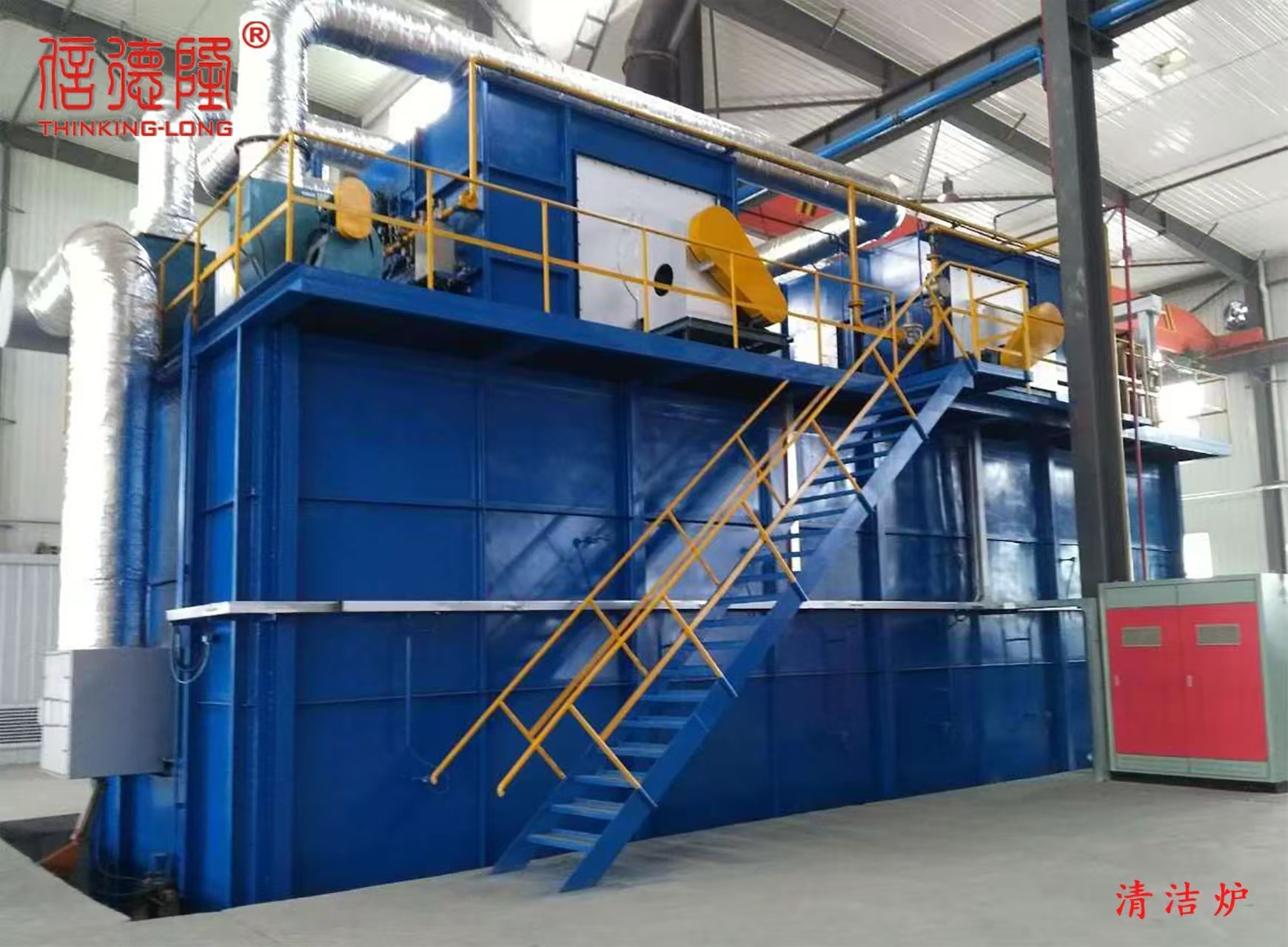
Solvent tanks work fine for stripping light grease or loosely adhered paint, but they start to struggle when the coating is thick, cured, or deeply embedded in recesses. A burn-off furnace simply walks through those jobs. Instead of waiting hours for chemicals to soften a heavy epoxy or powder coat, the furnace turns the organic material to ash in a single cycle. That speed matters when you're juggling a queue of parts that all need to be clean by Friday.
Another area where the furnace pulls ahead is with complex geometries. Solvent tends to pool in blind holes or leave residue inside welded seams, which means you're either hand-scrubbing afterward or running a second cycle and hoping for the best. A burn-off furnace doesn't care about shape. The heat reaches every surface, so the coating burns away uniformly, even inside a hollow tube or a deep channel. You end up with a part that's ready for blasting or recoating without any hidden pockets of old finish.
There's also the matter of what you're trying to remove. Some modern coatings are intentionally chemical-resistant—think high-solids epoxies or ceramic-based paints. A solvent tank can sit for days and barely soften the surface. A burn-off furnace, by contrast, just needs the right temperature and a bit of time. When you're dealing with stubborn, high-performance finishes, the furnace isn't just a better option; it's often the only option that doesn't involve endless soaking and manual scraping.
Building Precision into Every Heating Zone
Precision zoning starts with moving control away from a single hallway thermostat and into the spaces people actually occupy. Each zone gets its own setpoint curve, its own feedback loop, and its own response time, so a drafty entryway and a sun-loaded conference room no longer have to settle for the same boiler output. That means trimming individual loop temperatures, balancing flow at the manifold, and letting every room pull only the heat it actually needs.
The real difference shows up under changing loads. We tune valve stroke, pump speed, and reset schedules together, then watch data logging across morning warm-up, midday solar gain, and night setback. A zone calling for 68°F holds within half a degree, even when the zone next to it has already dropped back. That kind of stability doesn't come from a smarter thermostat alone—it comes from matching the mechanical response to each zone's thermal signature.
What you notice day to day is less hunting, fewer reheat cycles, and no more cold corners that push people to crank the whole building. The goal isn't just even temperature; it's a system that lets every room settle into its own steady state without nudging its neighbors. In practice, that reads as fewer complaints, lower fuel use, and a heating plant that runs like it was actually designed for the building it's in.
Why Emission Controls Are No Longer an Add-On
For years, emissions hardware was bolted on late in development—a catalytic converter here, a particulate filter there—just enough to pass a lab test. That era is over. Modern engines are designed around their aftertreatment systems from the first stroke of the CAD file. The diesel oxidation catalyst, SCR, and DPF are no longer downstream accessories; they’re part of the combustion strategy, influencing injection timing, EGR rates, and even piston bowl geometry. Pull one piece out, and the whole calibration falls apart.
Real-world driving regulations have forced this shift. Euro 6d and similar standards test vehicles in cold starts, steep grades, and stop-and-go traffic—conditions where a tacked-on catalyst never reaches light-off or a retrofit DPF clogs within weeks. Engineers now have to model thermal management, urea dosing, and ash accumulation during the concept phase, because a late add-on simply cannot meet the durability and emissions windows.
Fleet managers have also changed the conversation. Unplanned downtime from a failed emissions sensor or clogged filter costs more than the hardware itself. As a result, original equipment manufacturers treat emissions controls as a core reliability feature, not a compliance burden. The most competitive powertrains are those where emissions performance and fuel economy are optimized together, not traded against each other.
Turning Waste Heat into a Competitive Edge
Most factories still treat excess thermal output as a nuisance—something to vent, pipe away, or cool down before it damages equipment. That mindset leaves real money on the table. A foundry in Ohio, for instance, rerouted heat from its furnaces to preheat raw materials and cut natural gas use by 18% within a year.
The competitive edge comes from treating every stream of rejected heat as a potential input. Rather than installing one-size-fits-all recovery units, the most effective teams map where heat is generated, when it peaks, and what nearby processes could absorb it. That can mean running absorption chillers off engine exhaust, sending condenser water to dry product, or feeding low-grade warmth into district heating loops. The technology isn't exotic; the discipline of matching source to use is what separates leaders from laggards.
The payoff shows up in three places at once: lower fuel bills, smaller cooling loads, and a lighter carbon footprint that increasingly matters to industrial buyers. And because waste heat is usually a local resource, the savings don't depend on volatile energy markets or government incentives. Plants that make this shift early build a cost structure rivals can't easily copy—especially when heat recovery is woven into expansion plans rather than bolted on later.
How Chinese Furnace Makers Tackle Warpage and Residue
Chinese furnace manufacturers have shifted away from purely empirical fixes for warpage. Many now run thermal-stress simulations early in the design phase to map how different chamber geometries and heating cycles affect panel distortion. Instead of relying on thicker steel alone, they use a mix of high-alumina refractory linings and strategic expansion joints that let the structure breathe without permanent deformation.
Residue buildup gets tackled at the source. Burner nozzles are angled to reduce flame impingement on cold spots, which cuts down on unburned carbon and sticky deposits. In continuous furnaces, makers add gentle turbulence in the preheating zone so ash and scale fall into collection trays rather than baking onto the hearth. This approach reduces the need for aggressive chemical cleaning between batches.
Field data also plays a role. Some Chinese producers equip their furnaces with basic thermocouple arrays and pressure sensors tied to a simple PLC. When a customer reports warpage or residue, the logged data helps pinpoint whether the cause is an overshoot in ramp-up or a drop in air pressure. That feedback loop has led to quieter blowers, revised door seals, and more forgiving hold times at lower temperatures.
FAQ
A lot of Chinese builders lean into modular frames and quick customization. They often pair locally sourced heating elements with adjustable control loops so that each unit can be tuned to a specific polymer removal profile. This keeps lead times short while still hitting tight temperature uniformity specs.
Extrusion screws, spinnerets, filter packs, and injection molds come in caked with polymers, paints, powder coatings, and rubber. The furnaces strip those off through controlled pyrolysis. Some configurations also deal with oils and varnishes when the atmosphere inside is managed properly.
It is, as long as the temperature ramp and hold times are set for the specific alloy. The better Chinese models use multi-zone airflow to prevent hot spots, so even precision parts like blow molds keep their dimensions without warping.
Modern units typically use ceramic fiber insulation and recycle heat during the cooling phase. That alone can drop energy use by 30 to 40 percent against fluidized bed systems or open burn-off ovens.
Reputable manufacturers usually include remote diagnostics through a PLC interface, regional spare parts hubs, and commissioning support from engineers who know export standards. Operator training is often available in English or other major languages.
Yes, multi-chamber and car-bottom designs are common. One chamber can be cooling while another is loaded, which keeps throughput high for recycling lines and automotive parts remanufacturing.
Secondary afterburners are standard, and many models add scrubbers or baghouse filters for local air quality compliance. Higher-end systems use catalytic oxidation to cut down visible smoke and odor during the polymer burnout stage.
Conclusion
China's thermal cleaning equipment has evolved from a low-cost alternative into a precision-driven segment of industrial maintenance. The shift is most visible in the way burn-off furnaces now routinely outperform traditional solvent tanks: they strip polymers, paints, and cured resins without hazardous liquid waste, while programmable multi-zone heating eliminates cold spots that once caused uneven burnout. Manufacturers have moved beyond generic box ovens, embedding thermocouples and independent zone controls so that every heating zone follows a tightly defined ramp-and-soak profile. This focus on thermal uniformity means operators can process complex parts with thin walls or mixed metal alloys without guessing how a load will behave.
Emission controls are no longer an afterthought bolted onto export models; integrated afterburners and catalytic oxidation now come standard on many Chinese-built systems, scrubbing volatile organic compounds before they reach the stack. At the same time, waste heat recovery has become a differentiator, with heat exchangers feeding preheated combustion air or plant utilities, cutting energy costs by double-digit margins in continuous operation. The hardest engineering challenge remains warpage and residue, and Chinese furnace makers address it through controlled cooling zones, load-specific cycle recipes, and airflow designs that prevent thermal shock while still achieving clean metal surfaces. The result is equipment that competes on process discipline and energy efficiency, not just price.
Contact Us
Contact Person: Qian Xijun
Email: [email protected]
Tel/WhatsApp: 8613961736750
Website: https://www.thinkinglong.com/